What Makes a Cable Suitable for Harsh Environments?
Industrial environments are rarely forgiving. Heat, moisture, chemical exposure, ultraviolet radiation, and mechanical stress all challenge cable performance in ways that standard constructions—typically rated for 60–90°C and mild indoor conditions—are simply not designed to withstand. In process control, factory automation, energy production, and critical infrastructure, a single cable failure can trigger hours of unplanned downtime, safety incidents, or corrupted 4–20 mA signals that compromise entire loops. When reliability is non-negotiable, harsh environment cable design becomes a rigorous engineering discipline—not a catalog selection.
Key Engineering Factors in Harsh Environment Cable Design
The first consideration is temperature. Many industrial applications routinely exceed the 75°C or 90°C ratings of common PVC or XLPE cables. Continuous exposure to elevated temperatures accelerates insulation aging, raises dielectric loss, alters capacitance and impedance, and shortens service life exponentially. Near furnaces, boilers, steam lines, or engine compartments, engineers specify fluoropolymers such as FEP (fluorinated ethylene propylene), rated for continuous operation up to 200°C, and ETFE (ethylene tetrafluoroethylene, commonly known as Tefzel®), rated up to 150°C in standard grades with specialized formulations reaching 200°C. These materials preserve dielectric stability and mechanical integrity across wide temperature swings. At the opposite extreme, cables in refrigerated facilities, outdoor northern installations, or cryogenic processes must remain fully flexible at –70°C or lower without cracking under vibration or impact.
Chemical resistance is equally defining. Petrochemical plants, pharmaceutical manufacturing, food processing, and heavy industrial lines expose cables to hydrocarbons, solvents, acids, bases, fuels, and aggressive cleaning agents. Standard jackets can swell, crack, or dissolve within months, allowing conductor corrosion or electrical shorts. Jacket selection is therefore critical: polyurethane (PUR) delivers outstanding abrasion resistance paired with strong resistance to oils and many industrial chemicals while retaining flexibility even at low temperatures. For the most severe chemical environments, fluoropolymer jackets and insulations provide near-universal inertness, resisting virtually all aggressive substances without performance trade-offs.
Sunlight and ultraviolet exposure introduce a separate failure mode in rooftop runs, outdoor conduit, solar installations, or partially exposed cable trays. UV radiation breaks polymer chains, causing surface chalking, loss of elongation, embrittlement, and cracking well before the intended 20–30 year service life. UV-stable jacketing—achieved through carbon black, hindered amine light stabilizers (HALS), or inherently resistant materials such as fluoropolymers or properly compounded polyethylene—prevents photodegradation and maintains flame-retardant and mechanical properties over time.
Moisture and water ingress require proactive engineering. In washdown areas, underground ducts, humid tropical sites, or direct-burial applications, water migration along conductors increases capacitance, promotes electrolytic corrosion, and distorts low-voltage instrument signals. Water-blocking systems using super-absorbent swellable tapes, powders, or filling compounds expand on contact to form permanent longitudinal and radial barriers, preserving signal integrity and preventing internal corrosion.
Mechanical durability rounds out the requirements. Cables in robotic arms, festoon systems, conveyors, or drag chains must withstand millions of flex cycles, abrasion against sharp edges, cut-through during installation, and crush forces. High-flex conductor stranding, reinforced fillers, and tough outer jackets (often PUR or fluoropolymer) are engineered to exceed industry flex-life benchmarks while meeting strict minimum bend radii and impact standards. Constructions must meet or exceed relevant benchmarks such as UL 758 for appliance wiring, IEC 60228 for conductor classes, or specific flex-cycle tests (e.g., TIA-568 or custom OEM protocols).
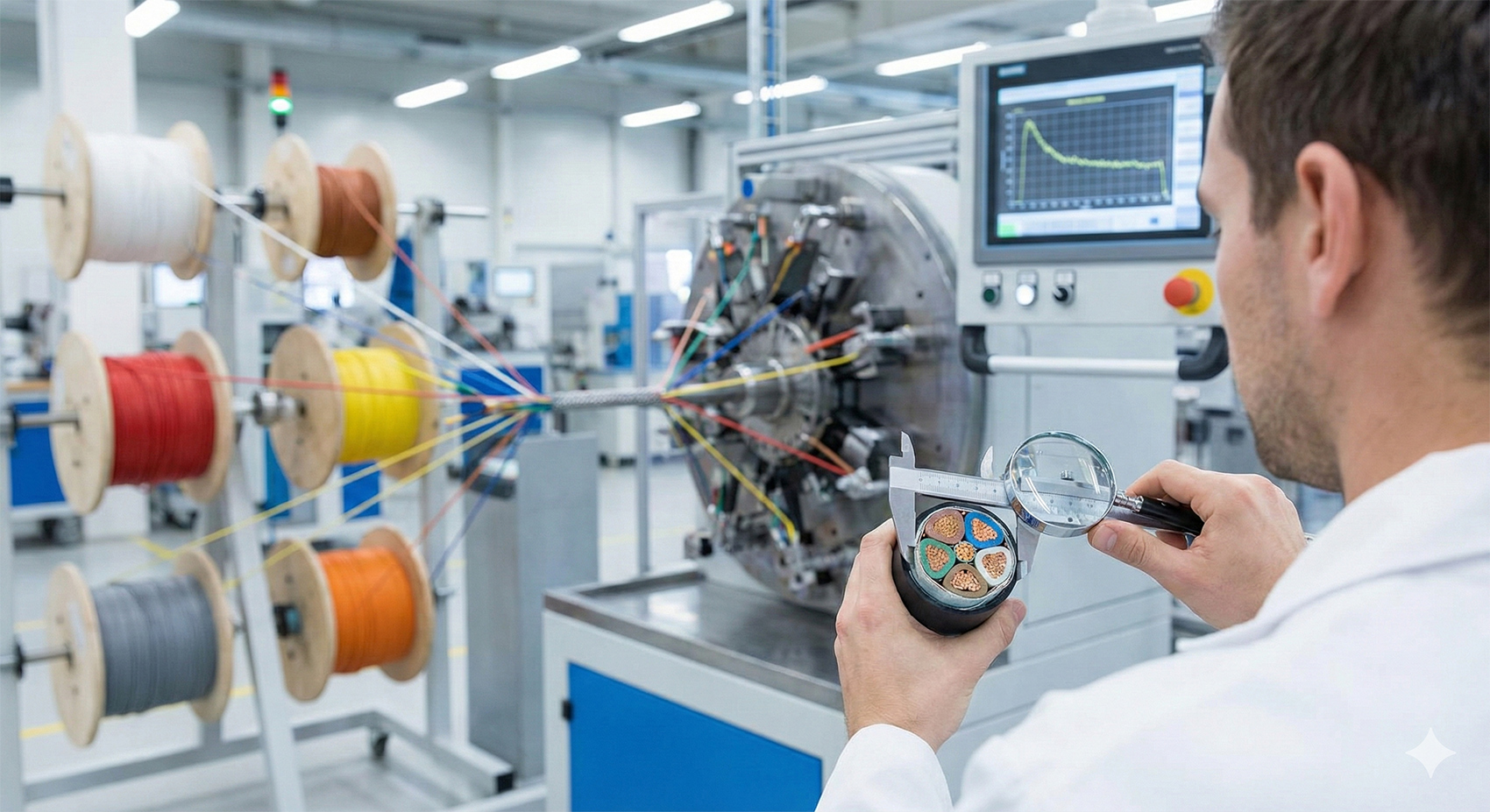
At General Wire Products, harsh environment cable design always starts by fully defining the application conditions. Our engineers review complete electrical parameters (voltage, shielding effectiveness, capacitance/impedance targets), environmental exposure profiles (temperature cycling data, chemical compatibility lists cross-referenced against material datasheets from DuPont or Arkema), mechanical stresses, and compliance requirements (NEC Article 725/800, UL listings, plenum CMP ratings) before finalizing every layer. Prototypes undergo accelerated aging, chemical immersion, UV chamber, and mechanical fatigue testing to validate real-world performance.
Common Questions on Harsh Environment Cable Design
- What’s the difference between FEP and ETFE? FEP offers superior chemical resistance and higher continuous temperature rating (up to 200°C), while ETFE provides better mechanical toughness, cut-through resistance, and radiation tolerance.
- When is custom design essential? For applications with combined extremes (e.g., high temperature + chemical exposure + repeated flexing) where off-the-shelf cables fail prematurely.
In harsh industrial settings, performance margins are razor-thin. Designing with the full environment in mind—rather than adapting a general-purpose cable—is what separates decades of trouble-free service from repeated failures and costly replacements.